profiq Video Demo: How to Set Up a JSON Web Server Using Go Technology

3 min read6.2.2025
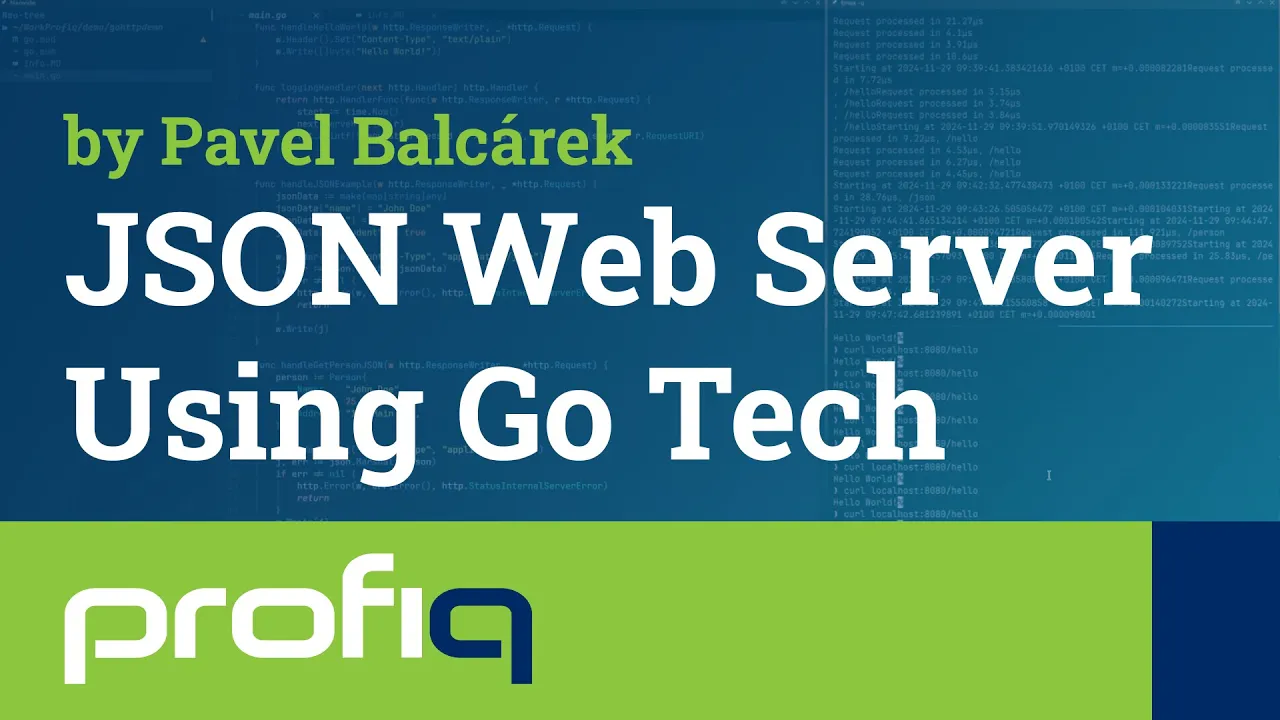
In this technical video demo,Pavel Balcárek, asoftware engineer at profiq walks through some foundational concepts for working with Go (Golang) to create HTTP servers, handle JSON, and even render simple web pages. If you’re looking to deepen your understanding of Go’s capabilities and standard library, this session offers plenty of practical value.
Here’s a highlight of what you’ll learn in the video:
1. Building an HTTP Server
Discover how to set up a basic HTTP server using Go’s robust standard library. The demo illustrates why learning the fundamentals is essential before diving into frameworks that abstract many details.
2. Handling Requests and Routing
Learn how to define routes, create handlers, and manage different HTTP methods. The session shows how to control the behavior of endpoints, including handling specific HTTP methods like GET and POST.
3. Working with JSON in Go
The demo covers how to:
- Marshal and unmarshal JSON using Go’s built-in JSON library.
- Use structs for clean and type-safe data handling.
- Manage errors effectively during JSON parsing and ensure graceful handling of incorrect data types.
4. Logging and Middleware
Understand how to implement basic middleware in Go to log incoming requests and measure processing time. This segment highlights the flexibility of Go’s chaining capabilities for middleware.
5. Rendering Templates
Dive into Go’s template engine for rendering dynamic web pages. You’ll see how to structure templates, bind struct data, and use Go’s template syntax to display content dynamically.
6. Exploring Advanced Tools For those ready to push further, the video introduces Temple, a Go library for building HTML templates with Go syntax, demonstrating how it can streamline template management and rendering for complex web applications.
This demo will help you learn Go or refine their foundational knowledge. You can gain hands-on experience with practical, real-world scenarios by exploring Go’s standard library before diving into external frameworks.
Whether you’re new to Go or looking to revisit its basics, this session offers a concise, code-driven exploration of key concepts for Go developers.
WATCH THE VIDEO
You May Also Like:
Why Go For Web Servers By Go Tech
Go Installation Guide
Evaluating LLMs with MLflow
Level Up: 10 Tips for Writing Better Code


Comments
Leave a Reply
Online comments are not active during the static migration phase.